About a quarter of the heat you pay for escapes through an uninsulated roof. Loft and attic insulation is the cheapest fix for that leak, and one of the few home upgrades that reliably pays for itself. This guide gives the real 2026 costs for the UK, the US and Germany, what each home can expect to save, and how long payback actually takes.
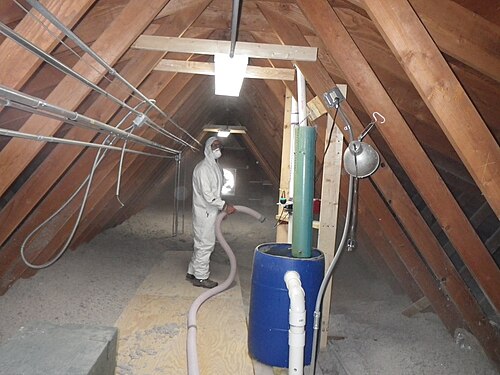
Photo: US Department of Energy, via Wikimedia Commons
United Kingdom: costs and savings (Energy Saving Trust)
The recommended depth for mineral wool loft insulation is 270mm, usually laid in two layers. The Energy Saving Trust's July 2026 estimates for insulating a completely uninsulated loft, in a gas heated home, are:
| Home type | Typical installed cost | Saving per year | Simple payback |
|---|---|---|---|
| Mid-terrace house | £650 | £140 | about 4.5 years |
| Semi-detached house | £750 | £190 | about 4 years |
| Detached house | £1,100 | £360 | about 3 years |
| Detached bungalow | £1,200 | £350 | about 3.5 years |
Insulation lasts around 40 years, so a three to four year payback is an excellent return. Two cautions. First, topping up matters much less: going from 120mm to 270mm typically costs £500 to £800 and saves only about £19 to £35 a year, so do it when you are working in the loft anyway, not as a standalone savings project. Second, check grants before paying anything: the Great British Insulation Scheme and ECO4 can cover the full cost for eligible households, including many renters.
United States: attic insulation costs
Most US attic jobs are blown-in fiberglass or cellulose. Angi and HomeAdvisor 2026 data puts installed prices at roughly $1.00 to $2.80 per square foot, with most whole projects landing between $900 and $3,600. A typical 1,000 square foot attic brought up to R-38 commonly costs $1,500 to $2,500. How much you need depends on climate: the Department of Energy recommends R-38 in warm zones and up to R-60 in the coldest.
| Item | Typical 2026 cost |
|---|---|
| Blown-in fiberglass or cellulose | $1.00 to $2.80 per sq ft installed |
| 1,000 sq ft attic to R-38 | $1,500 to $2,500 |
| Air sealing (worth bundling) | $300 to $1,500 |
| Removing old, damaged insulation | $1 to $3 per sq ft extra |
The EPA estimates that air sealing plus proper attic insulation saves around 15 percent on heating and cooling costs. On a $1,800 annual heating and cooling bill that is about $270 a year, putting a $2,000 job at roughly a seven year payback, faster in homes heated with oil, propane or electricity, slower where gas is cheap. Many big box stores also lend the blowing machine free with a minimum material purchase, which makes this one of the most realistic DIY energy projects.
Germany: often a legal duty, and subsidised
In Germany, insulating the top floor ceiling (oberste Geschossdecke) is not just an upgrade: for many older homes it has been a legal requirement under the Building Energy Act (GEG) since 2015, applying when a home is bought or inherited. Typical 2026 costs are about €25 to €50 per square metre for blown-in insulation of a non-walkable ceiling, and €50 to €90 per square metre for a walkable, boarded finish. Federal BEG funding covers 15 percent of the cost, rising to 20 percent with an individual renovation roadmap (iSFP). For a 100 square metre ceiling at €3,500 before subsidy, expect heating savings in the region of €250 to €400 a year, depending on the fuel replaced.
DIY or hire a pro?
DIY is realistic when the loft or attic is empty, easy to access and free of wiring and moisture problems. In the UK, mineral wool rolls for a semi-detached home cost roughly £200 to £400 in materials. Hire a pro when the space holds a water tank, downlights, a bathroom fan vent, or any sign of damp, and always in the US if ducts or an air handler sit in the attic, because the air sealing around them is where much of the saving lives. Never squash insulation under storage boards: raise the boards on legs or battens so the full depth survives.
Frequently asked questions
How much insulation do I need?
In the UK, 270mm of mineral wool. In the US, the DOE target ranges from R-30 in the warmest zones to R-60 in the coldest, with R-38 to R-49 right for most homes. In Germany, the GEG standard for the top floor ceiling is a U-value of 0.24 W/m²K or better.
Is loft insulation worth it if I already have some?
If you have less than about 100mm, yes, the payback is strong. If you already have 120mm or more, topping up saves little each year, so treat it as a comfort upgrade or bundle it with other loft work.
Does insulation help in summer?
Yes. The same layer that keeps heat in during winter slows heat coming through the roof on hot days, which is why insulated top floor rooms overheat less.
Sources: Energy Saving Trust loft insulation estimates, July 2026; Angi and HomeAdvisor attic insulation cost data 2026; US Department of Energy insulation guidance; US EPA Energy Star sealing and insulating estimates; German GEG and BEG funding rules. Figures checked October 2026.