Installation prices get all the attention, but the number that decides whether a heat pump saves you money is the monthly running cost. So here it is, worked out properly for a typical home in the UK, the US and Germany, using official electricity prices and real world efficiency figures from field studies, not brochure promises.
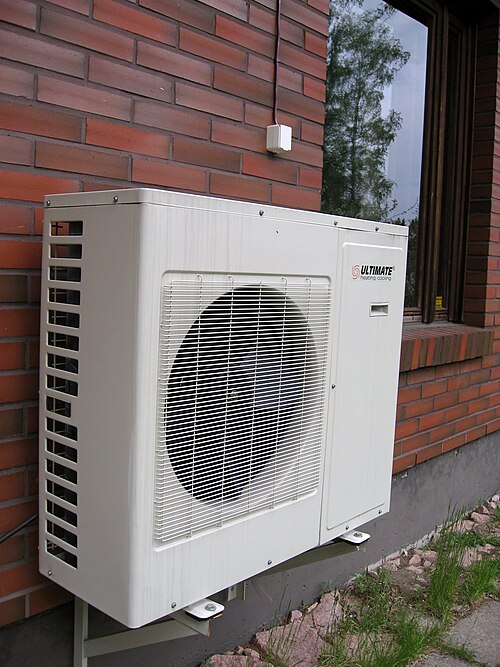
Photo: Wikimedia Commons
Quick answer (prices checked 23 October 2026): for a home needing 12,000 kWh of heat a year in the UK or Germany, or 30,000 kWh in a colder, larger US home:
| Country | Electricity used | Cost per year | Average month | Coldest month |
|---|---|---|---|---|
| United Kingdom | about 4,140 kWh | £1,089 | £91 | about £163 (January) |
| Germany | about 3,750 kWh | €1,424 | €119 | about €214 (January) |
| United States | about 10,000 kWh | $1,823 | $152 | about $450 |
Two honest warnings before the detail. First, nobody's bill is the average month: heating follows the weather, so winter months cost two to three times the summer ones. Second, your result depends mostly on one number, your system's real efficiency, called SPF or COP. We explain both below.
United Kingdom: about £91 a month on the standard tariff
A typical UK home needs around 12,000 kWh of heat a year. The Electrification of Heat trial, run with real households, measured a median seasonal performance factor (SPF) of 2.78, and well installed modern systems do better, so we use a fair middle figure of 2.9. That means the heat pump draws about 4,140 kWh of electricity a year.
At the Ofgem price cap for October to December 2026, 26.32p per kWh, that is £1,089 a year, or £91 in an average month. January alone, with roughly 15 percent of the year's heating in one month, comes to about £163.
Two comparisons put that in context:
- Gas boiler: the same 12,000 kWh of heat from a 90 percent efficient boiler at the capped gas price of 7.97p per kWh costs about £89 a month for the gas itself. On standard tariffs, in other words, a heat pump and a modern gas boiler cost almost the same to run in the UK right now.
- Heat pump tariff: specialist tariffs with cheaper off peak rates bring the effective price down, and the same home lands at roughly £65 a month. The tariff choice is worth more than most people expect.
Germany: about €119 a month
German homes in the Fraunhofer ISE field study achieved an average SPF of 3.4 for air source heat pumps; we use a more cautious 3.2. For 12,000 kWh of heat, that is about 3,750 kWh of electricity.
At the average household electricity price for the first half of 2026 reported by Destatis, 37.97 cents per kWh, the bill is €1,424 a year, about €119 a month, with January at roughly €214. Households on newer contracts, which Destatis puts at 34.87 cents, pay closer to €109 a month. Gas at 11.58 cents per kWh makes a gas boiler noticeably more expensive per unit of heat in Germany, which is why the running cost argument for heat pumps is strongest there.
United States: about $152 a month, with a cold weather catch
American homes are bigger and many heating climates are colder, so we use 30,000 kWh of heat a year. At a seasonal COP of 3.0, the heat pump uses about 10,000 kWh of electricity. At the EIA's winter outlook price of 18.23 cents per kWh, that is $1,823 a year, about $152 in an average month.
The catch is the coldest month. When temperatures fall hard, a heat pump's efficiency drops, and at a COP of 2.2 the coldest month alone can reach about $450. This is why cold climate models and correct sizing matter so much in the northern states, a point we also make in our guide to the cheapest way to heat a home.
For the same 30,000 kWh of heat, a 90 percent efficient gas furnace at the EIA's winter gas price of $13.44 per Mcf costs about $123 a month. Where US gas is cheap, it still beats a heat pump on running cost alone; the heat pump's case rests on replacing air conditioning too and on avoiding oil or propane, which are far pricier.
Why January costs so much more
Two effects stack up. Your home simply needs much more heat in midwinter, around 15 percent of the year's total in January in the UK and Germany. And a heat pump works hardest exactly then, because efficiency falls as the outside air gets colder. A system averaging an SPF of 3 across the year may run at 2.2 to 2.5 on the coldest days. Any quote that spreads the yearly cost evenly across twelve months is flattering the numbers.
Work out your own monthly cost
The maths is simpler than most installers make it sound:
- Step 1: find your yearly heating use. In the UK it is on your energy bill in kWh; a typical house is 11,000 to 13,000 kWh of gas for heating.
- Step 2: divide by the SPF you expect. Use 2.8 to 3.0 for a realistic UK air source system, 3.2 for Germany, and a COP of 3.0 for a mild to mixed US climate, less in very cold states.
- Step 3: multiply by your electricity price per kWh, then divide by 12 for the average month. Multiply the monthly figure by about 1.8 for a January estimate.
If you are still deciding whether to switch at all, our 10 year boiler vs heat pump comparison puts these running costs next to installation and servicing, and the heat pump cost guide covers what you will pay to install one in each country.
What changes your bill the most
- Efficiency (SPF): moving from 2.6 to 3.2 cuts the electricity needed by almost a fifth. Good design, big enough radiators and a low flow temperature are what get you there.
- Tariff: in the UK, a heat pump tariff can take roughly a quarter off the standard tariff bill in our example.
- Insulation: a home needing 9,000 kWh of heat instead of 12,000 pays a quarter less every single month. Our loft insulation cost guide shows why it is usually the first job to do.
- Controls: steady low temperature running beats big on and off swings; a smart thermostat helps, though by less than the adverts claim.
Frequently asked questions
Is a heat pump cheaper to run than a gas boiler? In Germany, yes, clearly. In the UK, about the same on standard tariffs and cheaper on a heat pump tariff. In the US, it depends on your state: gas is cheap in much of the country, while homes on oil or propane save a lot by switching.
Why do some owners report much higher bills? Usually a low SPF from a poorly designed system, a home with high heat loss, or a tariff that penalises daytime use. The technology is rarely the whole story.
Does a heat pump cost more to run in a cold snap? Yes. Efficiency falls as temperatures drop, and many systems use a backup heater in extreme cold. Budget for the coldest month, not the average one.
Should I budget monthly or yearly? Yearly. Monthly direct debits smooth the cost, but the honest figure is the annual total divided across the seasons as we have shown.
Sources: Ofgem price cap October to December 2026; Destatis household energy prices, first half 2026; US Energy Information Administration winter fuels outlook; Electrification of Heat trial results; Fraunhofer ISE heat pump field study. Prices checked 23 October 2026. Figures are worked examples for the stated heat demands, not quotes; your home's heat loss and system design will move them.